
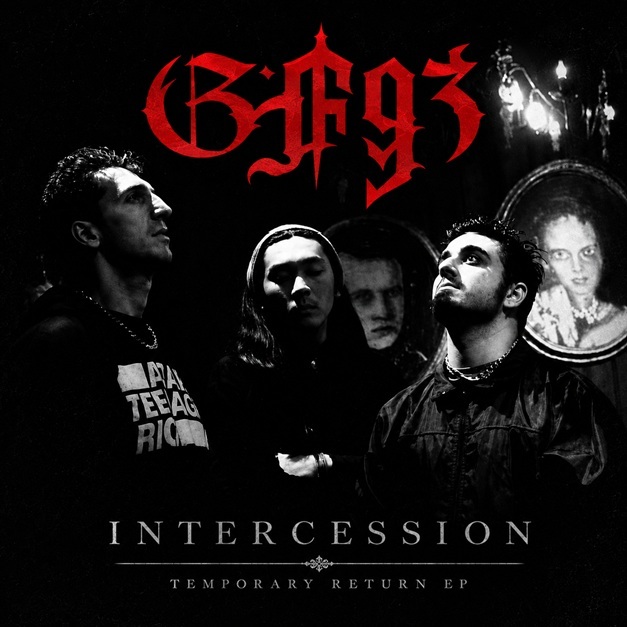
GF93 Return After 22 Years with Intercession, Temporary Return EP
Italian alternative metal veterans GF93 have returned after a 22-year recording gap with Intercession, Temporary Return, a three-track EP that revisits material from the band’s earlier catalogue. Rather than treating the comeback as a straightforward reissue, GF93 have rebuilt “Crist Buck RU,” “Demonology” and “Lost Boy” with slower tempos, deeper layers of reverb and a heavier sense of space.
The result is positioned less as a nostalgic summary and more as a conversation with the band’s past. The original songs came from a group that spent the late 1990s and early 2000s moving between industrial metal, hardcore, nu metal and increasingly personal forms of alternative music. On the new EP, those older structures are presented through a colder and more atmospheric frame.
Old songs viewed from a different distance
There is an obvious risk whenever a band returns by reworking established material. Updated production can polish away the character that made the originals worth revisiting, while overly faithful versions may offer little beyond improved sound quality. GF93 have chosen another route. By reducing the pace and widening the ambience, the band shifts attention from impact alone toward tension, decay and memory.
That approach suits a return after more than two decades. Intercession, Temporary Return does not pretend that no time has passed. Instead, the arrangements use that distance as part of the release’s identity. The songs feel presented as remnants recovered from an earlier period, then deliberately reshaped rather than restored.
The EP is available through the band’s official streaming page.
Crist Buck RU
“Crist Buck RU” opens the set and establishes the release’s altered scale. The slower treatment gives the composition more room to breathe, while the reverb pulls its industrial and alternative-metal elements into a more cavernous setting. What may once have been heard primarily as confrontation now carries the weight of something being remembered from a distance.
Watch “Crist Buck RU” on YouTube.
RU Demonology
“RU Demonology” carries perhaps the clearest connection to the uneasy, sinister atmosphere associated with GF93’s earlier work. The new version does not simply rely on heaviness. Its impact comes from restraint, with the reduced tempo allowing each phrase to hang longer than expected. That choice makes the track feel less immediate but more oppressive, as though the song has been stretched into a slow-moving warning.
Watch “RU Demonology” on YouTube.
Lost Boy
“Lost Boy” closes the EP and gives the release its most reflective moment. Within the context of a long-delayed return, the title takes on an additional resonance. The spacious production and slowed pulse make the song feel less like a final burst of aggression and more like an unresolved afterimage. It is a fitting ending for a release that looks backward without presenting the past as something fixed or comfortable.
A catalogue built on constant change
GF93 formed in Italy in 1996. The band’s recorded history includes Beaten (1997), G.oetia F.etish 19.93 (1999), Convulse All-Star (2002) and OSR (2004), a sequence also documented in the band’s AllMusic discography. Across those records, GF93 repeatedly altered the balance between industrial textures, hardcore force, alternative-metal hooks and experimental atmosphere.
The debut Beaten was produced by Paolo Favati, whose credits include work connected to Einstürzende Neubauten, Pankow and Dive. G.oetia F.etish 19.93 followed through the UK’s Copro Records, with Dave Chang handling production. By the time of Convulse All-Star, the band had developed a heavier and more melodic attack, supported by European touring and appearances alongside acts including Earthtone9, Misery Loves Co., NOFX and W.A.S.P.
OSR, short for Own Style Research, pushed the band further away from a single genre identity. In a 2005 MetalItalia interview, founder and vocalist Carlo Bellotti said he wanted to “create something that could remain credible over time through an evolutionary path,” translated from the original Italian. That statement provides useful context for the new EP. Reworking the old songs is consistent with a band that historically treated change as part of its core identity.
How the earlier material was received
Independent coverage of the new EP is still limited at the time of publication, but GF93’s earlier output did attract positive critical attention. A 2005 Metalrage review of OSR described the band as a “fresh wind into the nu-metal scene,” while praising the record’s memorable songwriting, tight guitars and distinctive vocal approach. The review also noted connections to Converge, Deftones, Korn and At the Drive-In without suggesting GF93 were simply copying those bands.
That history matters because Intercession, Temporary Return is not arriving from a group whose identity can be reduced to one trend. GF93’s catalogue came from a period when industrial metal, hardcore and nu metal frequently overlapped, but the band’s strongest work was shaped by its refusal to settle permanently into any one of those categories.
A return that does not erase the years
The most convincing aspect of Intercession, Temporary Return is its unwillingness to present the comeback as a simple rewind. The songs are recognizably connected to GF93’s earlier catalogue, yet the slower tempos and heavy ambience allow the passage of time to remain audible in the concept. This is not a greatest-hits package, and it is not a collection of untouched archive recordings. It is a compact attempt to test whether old material can survive a new emotional setting.
For longtime listeners, the EP offers a darker route back into the catalogue. For newcomers, it works as a concise introduction to a band whose history was built around mutation, discomfort and a persistent search for its own sound. Whether this temporary return develops into a longer second chapter remains open, but these three reimagined tracks make the return feel purposeful rather than ceremonial.